

How It Works
Draftt follows the same loop for every connected repository:- Connect: Install the Draftt.io GitHub App on your organization and choose which repositories Draftt can read. See GitHub. This is a separate app from the Draftt CI GitHub App, which scans Terraform plans on pull requests. Draftt also scans Azure DevOps repositories through the same Azure DevOps integration you use for ticketing.
- Discover: Draftt reads build files and lockfiles at the head of each repository’s configured branch, mapping every project to the libraries it depends on. To scan a different branch, contact Draftt.
- Analyze: Draftt checks each dependency version for end of life, deprecation, and maintenance activity, and identifies the version required to stay supported.
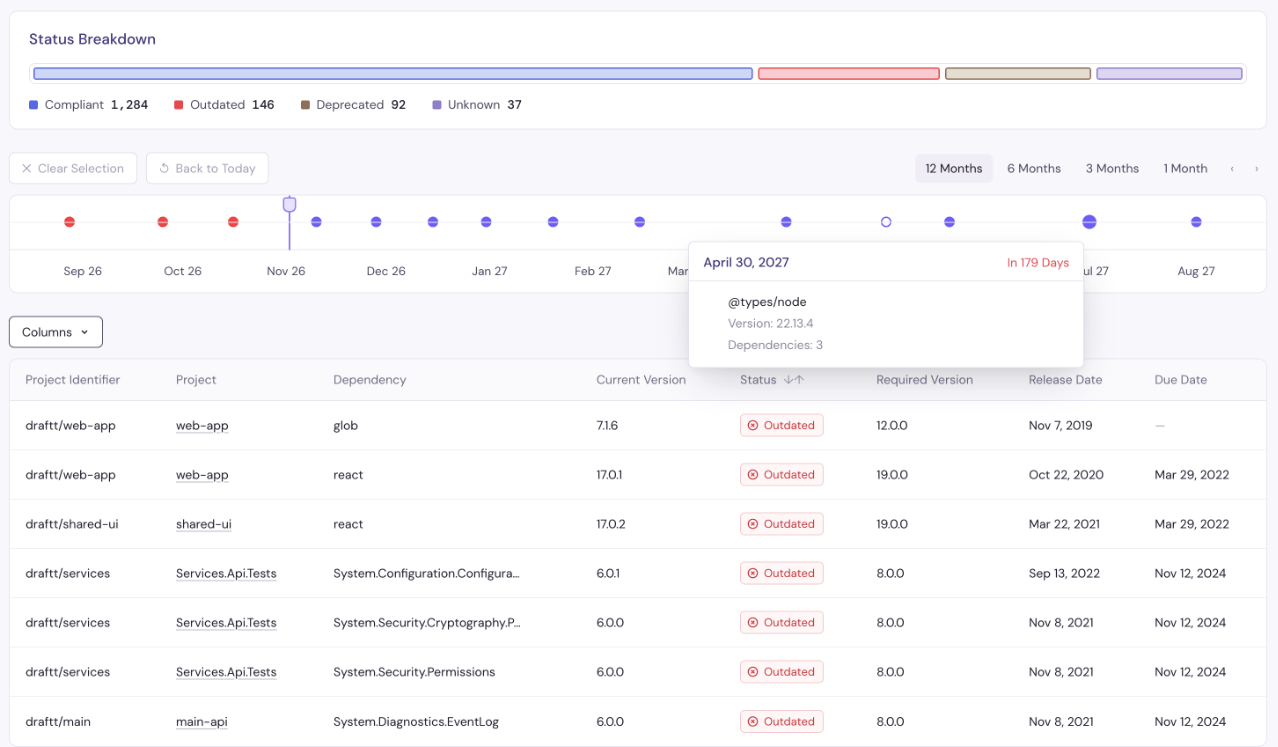
- Surface: Results appear in the Code area of Draftt, with a status, required version, and due date for each dependency.
Dependency Statuses
Draftt assigns each dependency a status based on its current version:Suggested Alternatives
When a dependency is deprecated or no longer maintained, upgrading to a newer version isn’t enough. Draftt suggests a replacement library when one exists, so your team can plan a migration instead of searching for an alternative.Code Inventory
The Code Inventory shows every dependency Draftt has discovered across your connected repositories, together with its status, required version, and due date. The Status Breakdown at the top shows how many dependencies fall under each status, so you can gauge the overall health of your code dependencies at a glance.Common Use Cases
- Get visibility into what your code depends on: See every library and version used across your projects and repositories in one place.
- Prioritize upgrade work: Focus on outdated and deprecated dependencies first, and use due dates to sequence the rest.
- Plan ahead: See which dependencies reach end of support in the coming months, and schedule upgrades before they become urgent.
- Plan migration of unmaintained libraries: Identify deprecated and archived packages and move to a suggested alternative.
- Manage code and infrastructure debt in one place: Track code dependencies next to your cloud, Kubernetes, and data platform resources, with the same statuses and due dates.